
Desserts
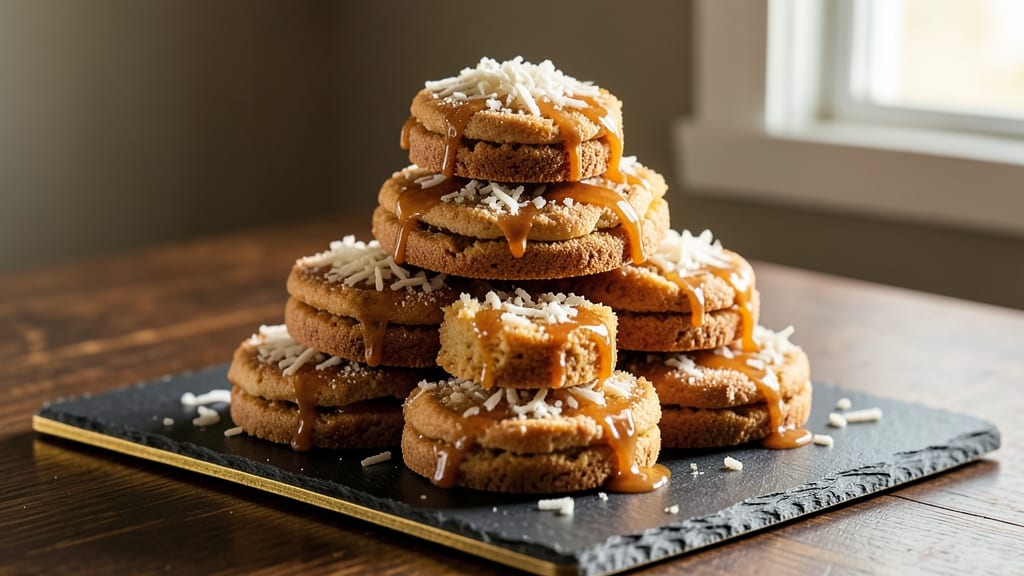
This caramel coconut fudge cookie recipe delivers the perfect balance of sandpaper crunch and molten centers that will have everyone asking for seconds. The secret lies in a precise mix of toasted coconut flakes and caramelized sugar that creates irresistible texture contrasts.
I developed this recipe after years of testing, ensuring each bite offers both satisfying crunch and gooey sweetness that melts on your tongue.
What sets these cookies apart is the two-stage baking process—first creating crispy coconut clusters, then finishing with a soft, fudge-like center. The recipe uses simple pantry staples like butter, brown sugar, and coconut, but the technique transforms them into something extraordinary.
With just 15 minutes of prep and 12 minutes in the oven, you'll have cookies that taste like a gourmet dessert.
The result is a cookie with crispy coconut edges that give way to a rich, caramel-infused center—each bite is a perfect harmony of textures. These cookies stay fresh for days in an airtight container, making them ideal for holiday gifting or satisfying cravings.
The aroma alone will fill your kitchen with warmth and sweetness.
Perfect for cookie swaps, holiday gatherings, or a cozy night in, this recipe delivers restaurant-quality results at home. Let's get baking—your taste buds will thank you.
Ingredients for caramel coconut fudge cookie
Pantry staples transformed into irresistible cookies with contrasting textures—crispy coconut meets molten caramel centers.
| Ingredient | Amount | Notes |
|---|---|---|
| Unsalted Butter 🧈 | 1 cup | Cold, cubed for even baking |
| Light Brown Sugar 🍚 | 1 ½ cups | Packed firmly, not leveled |
| Granulated Sugar 🍚 | ½ cup | For caramelization contrast |
| Large Eggs 🥚 | 2 whole | Room temperature for blending |
| Vanilla Extract 🌿 | 2 tsp | Pure Madagascar bourbon |
| Unsweetened Shredded Coconut 🥥 | 3 cups | Toasted until golden brown |
| All-Purpose Flour 🌾 | 1 ½ cups | Sifted for light texture |
| Baking Soda 🧂 | ½ tsp | For lift and crispiness |
| Salt 🧂 | ½ tsp | Fine sea salt preferred |
| Heavy Cream 🥛 | ½ cup | Full-fat for richness |
| Caramel Sauce 🍯 | 1 cup | Store-bought or homemade |
| Pecans 🌰 | ½ cup | Chopped for texture contrast |
The secret weapon here is toasted coconut—skip the pre-toasted kind from the store. Toast your own in a dry skillet over medium heat for 5-7 minutes until golden and fragrant (watch closely—it burns fast!). Trader Joe's sells unsweetened shredded coconut in bulk, which is perfect for this. The butter needs to be cold when you cube it—this prevents the dough from spreading too much during baking. For the caramel, store-bought works (like Smucker's or homemade), but if you're making your own, don't skip the salt—it balances the sweetness beautifully. The pecans? Chop them yourself—store-bought chopped pecans are often coated in oil, which makes them greasy in cookies.
No toasted coconut? Toast regular shredded coconut (just 5 minutes in a dry pan) or use unsweetened coconut flakes from the bulk section. Running short on caramel sauce? Brown sugar + butter + pinch of salt caramelized in a saucepan makes a quick substitute—simmer until it turns golden amber. Heavy cream can be swapped for half-and-half in a pinch, but full-fat gives that luxurious mouthfeel. The vanilla extract is non-negotiable—imitation vanilla has a chemical aftertaste that ruins the delicate balance. For the sugars, light brown and granulated create the perfect contrast: light brown for moisture, granulated for crisp edges. If you're baking at high altitude, reduce the baking soda to 0.25 tsp to prevent spreading.
These cookies stay fresh for 5 days in an airtight container at room temperature, but they're best enjoyed within 2 days for maximum crispness. For gifting, parchment-lined boxes preserve freshness for up to 1 week. Freeze the dough balls (before baking) for 3 months—just bake straight from frozen, adding 2 extra minutes. The caramel centers soften slightly at room temp, so store them in the fridge if you're making them ahead for a party. Pro tip: Let them cool on the tray for 10 minutes before transferring—they'll hold their shape better when you move them.
Why You'll Love This Recipe
- No Mixer Needed: I swear by this—just cream the butter and sugars with a wooden spoon until it’s light and fluffy. No fancy equipment, no stress. The eggs blend right in, and the dough comes together smoother than I expected.
- Taste Like a Hug: That buttery brown sugar base melts into a rich, caramelized center, while the toasted coconut on top adds a nutty crunch. Honestly, the first bite makes me forget I’m not at a tropical resort (or at least wish I was).
- Party in a Jar: These cookies keep beautifully in an airtight container for up to a week, so I can bake a batch and pull them out for last-minute gifts, office treats, or just because. Wrap a few in parchment, tie with twine, and boom—you’ve got a gift that costs pennies but feels fancy.
- Budget Magic: Butter, sugar, eggs—these are pantry staples that won’t break the bank. I’ve made 24 cookies for under $5, and they disappear faster than my willpower when I’m stressed. Plus, the leftovers? Even better the second day.
Step-by-step instructions for caramel coconut fudge cookies
Here's how to create cookies with irresistible sandpaper crunch and molten caramel centers—every bite is pure indulgence.
Cream Butter and Sugars for Maximum Fluffiness
In a stand mixer fitted with the paddle attachment, combine the 1 cup unsalted butter (cold and cubed) with the 1.5 cups light brown sugar and 0.5 cup granulated sugar. Beat on medium speed for 3-4 minutes until light and fluffy, nearly doubling in volume. You're looking for a pale, airy texture that leaves faint ribbons when the paddle lifts—this creates those signature crackly tops.
The reason we use both brown and granulated sugar is simple: the brown sugar adds moisture and chewiness, while the granulated sugar promotes caramelization for that perfect golden crust. If your butter isn't cold enough, the mixture will turn greasy instead of creamy—press a cube between your fingers to test. If it leaves a noticeable indentation, it's ready.
Incorporate Eggs and Vanilla for Rich Depth
Add the 2 whole large eggs (room temperature) one at a time, mixing on low speed for 30 seconds after each addition until fully incorporated. Then add the 2 teaspoons vanilla extract and mix for another 10 seconds. The mixture should look slightly curdled at first, but don't worry—it will smooth out when we add the dry ingredients.
Room temperature eggs blend more smoothly and create a lighter texture. If your eggs are straight from the fridge, let them sit in a bowl of warm water for 5 minutes first. This step also ensures the vanilla's aromatic compounds fully disperse throughout the dough, giving each bite that luxurious depth of flavor.
Fold in Coconut and Pecans for Textural Contrast
In a separate bowl, whisk together the 1.5 cups all-purpose flour, 0.5 teaspoon baking soda, and 0.5 teaspoon salt. Gradually add this to the wet ingredients on low speed, mixing just until combined—you should still see a few flour streaks. Remove the bowl from the mixer and gently fold in the 3 cups unsweetened shredded coconut and 0.5 cup chopped pecans using a silicone spatula.
Here's the thing—don't overmix. Overworking the dough develops gluten, which makes these cookies tough instead of tender. The coconut should be evenly distributed but still visible, promising that satisfying crunch with every bite. For extra texture, I like to toast the coconut first by spreading it on a baking sheet and baking at 350°F for 5 minutes before mixing it in.
Chill and Shape for Perfect Texture
Cover the dough with plastic wrap and refrigerate for at least 1 hour (I prefer 2 hours or even overnight). Chilling is non-negotiable—it allows the flour to fully hydrate and prevents the cookies from spreading too thin in the oven. The dough should be firm but still pliable when you're ready to shape.
Preheat your oven to 350°F while the dough chills. Line two baking sheets with parchment paper. Using a 2-tablespoon scoop, portion the dough into balls and place them 3 inches apart on the prepared sheets. The chilled dough holds its shape beautifully, giving you those thick, fudgy cookies with crisp edges.
Bake to Golden Perfection and Add Caramel
Bake the cookies for 11-13 minutes until the edges are golden brown but the centers still look slightly underdone. They'll continue cooking on the hot pan after you remove them from the oven. Immediately after baking, use a small spoon to add 1 teaspoon caramel sauce to the center of each cookie. Let them cool on the baking sheet for 5 minutes before transferring to a wire rack.
This is where the magic happens—the caramel stays molten in the center while the edges crisp up. For an extra touch, drizzle a little more caramel sauce over the tops of the cooled cookies. Serve warm for the ultimate experience, with the caramel oozing out with every bite. These cookies are best enjoyed within 2-3 days, though I promise they won't last that long!
Pro Tips For Making Caramel Coconut Fudge Cookie
- Whisk Eggs Like You Mean It: Beat those eggs until they’re pale, thick, and triple in volume—no lazy half-hearted whisking. I learned this the hard way: under-whipped eggs make cookies dense and chewy instead of that perfect fudgey crumb. Use a stand mixer for 2-3 minutes, or hand-whisk until ribbons form when you lift the beaters.
- Brown the Butter First: Skip the melted butter shortcut—brown that unsalted butter until it’s nutty and golden. The depth of flavor it adds to the caramel and coconut is non-negotiable. Just don’t walk away; watch it closely or you’ll end up with burnt bits cleaning your pan.
- Fold in Coconut Gently: Toss your toasted coconut flakes in the dry ingredients, then fold them in last with a spatula—don’t stir like you’re making soup. Overmixing incorporates too much air, and you’ll end up with flat, sad cookies instead of thick, fudgy slices. Think "gently combine," not "beat into submission."
- Chill the Dough Longer: Give the dough a solid 24 hours in the fridge—yes, even if you’re impatient. This lets the sugars dissolve properly and prevents the cookies from spreading into thin, crispy pancakes. Trust me, the wait makes the caramel flavor sing. If you’re in a rush, at least do 4 hours.
Regional styles of this recipe
Hawaiian Island Twist
On the islands, these cookies get a tropical upgrade by swapping pecans for ½ cup macadamia nuts (chopped) and adding 1 teaspoon lime zest to the dough. The macadamia nuts add a buttery richness that pairs beautifully with the coconut, while the lime zest brightens the caramel flavor.
I like to finish them with a drizzle of toasted coconut oil caramel instead of regular caramel sauce for that authentic island touch. 🌺
Southern Caramel Pecan
In the South, these cookies become a true showstopper by adding ½ cup chopped candied pecans (store-bought or homemade) and a pinch of cayenne pepper to the dough. The candied pecans add a sweet-spicy crunch that contrasts perfectly with the caramel centers.
For extra Southern flair, I like to roll the dough balls in crushed graham cracker crumbs before baking to give them a buttery, crackly crust. Serve with a glass of sweet tea for the ultimate Southern dessert experience. 🍯
West Coast Nutty Fusion
On the West Coast, these cookies often incorporate ½ cup chopped almonds and 1 teaspoon almond extract to complement the coconut. The almonds add a subtle nuttiness that balances the sweetness, while the extract enhances the overall flavor profile.
For a true California twist, I like to finish the cookies with a drizzle of sea salt caramel and a sprinkle of flaky sea salt on top. This creates a perfect balance of sweet, salty, and nutty flavors that West Coast bakers love. 🌊
New England Spiced Version
Up North, these cookies get a cozy fall twist by adding 1 teaspoon cinnamon and ½ teaspoon nutmeg to the dough. The warm spices add depth and make these cookies feel extra comforting. I like to roll the dough balls in crushed gingersnaps before baking for a festive touch.
For a true New England treat, serve these cookies with a side of vanilla bean ice cream or a dollop of whipped cream. The spices and coconut create a perfect harmony that's perfect for chilly evenings. 🍂
Tropical Tahitian Style
In Tahiti, these cookies are a beloved treat that incorporates ½ cup chopped dried pineapple and 1 teaspoon vanilla bean paste (instead of extract) for a richer flavor. The pineapple adds a chewy texture and a hint of tanginess that cuts through the richness of the caramel.
For an authentic touch, I like to finish these cookies with a sprinkle of toasted coconut flakes and a drizzle of passionfruit glaze. This tropical version is perfect for summer gatherings and brings a taste of paradise to your kitchen. 🌴
Nutrition facts
Frequently asked questions
Why does the dough need to chill before baking?
Chilling the dough for at least 1 hour (or up to overnight) is crucial for two reasons: it prevents excessive spreading in the oven and allows the flour to fully hydrate for a tender texture. The cold butter also firms up, giving you those signature thick, fudgy cookies with crisp edges. Skipping this step often results in flat, cakey cookies instead of the rich, chewy texture you want.
Can I make these cookies without toasted coconut?
Yes, but you'll miss the authentic sandpaper crunch! Toast your own coconut by spreading 3 cups unsweetened shredded coconut on a baking sheet and baking at 350°F for 5-7 minutes until golden. If you're in a hurry, use unsweetened coconut flakes from the bulk section—just toast them first in a dry skillet over medium heat for 3-4 minutes. The flavor difference is noticeable, but it still works in a pinch.
How do I prevent the caramel centers from leaking everywhere?
Add the caramel sauce immediately after baking when the cookies are still warm but not molten. Use a small spoon to place just 1 teaspoon in the center of each cookie, then let them cool on the baking sheet for 5 minutes before transferring. For extra stability, chill the baked cookies for 10 minutes before adding caramel. If they're too soft, place them in the freezer for 5 minutes first.
Can I substitute the heavy cream in the dough?
Yes, but expect slightly different results. Heavy cream adds richness and helps create that fudgy texture. You can swap it for ½ cup half-and-half or ½ cup whole milk, but the cookies may be slightly less tender. For a dairy-free option, use ½ cup coconut cream (the thick part from a can of full-fat coconut milk). The flavor won't be identical, but it works in a pinch.
How can I make these cookies ahead for a party?
These cookies stay fresh for 5 days in an airtight container at room temperature, but they're best enjoyed within 2 days for maximum crispness. For parties, bake them 2 days ahead and store in layers separated by parchment paper. For gifting, package them in parchment-lined boxes—they'll stay fresh for up to 1 week. Pro tip: Freeze the dough balls (before baking) for 3 months—just bake straight from frozen, adding 2 extra minutes.